"Can We Just Add a Sentence?" What "As-Is" Really Means in a Virginia Contract
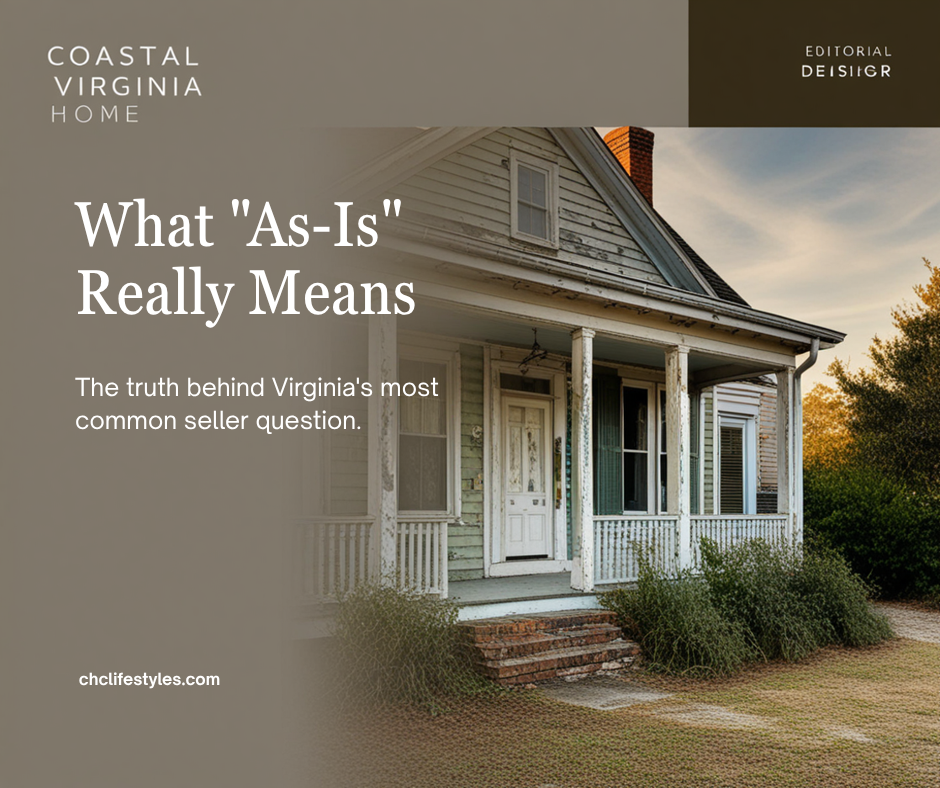
A seller asked me something recently that comes up more than almost any other question I get: "Can we just add a sentence saying the home conveys as-is?" It's a completely reasonable thing to ask. But the honest answer surprises most people — in the vast majority of Virginia sales, that sentence wouldn't create anything new. It would just be writing down something that's already true.
As-Is Is Already the Default — Not Because of a Sentence
Virginia's Residential Property Disclosure Act already sets the baseline for most residential sales in this state: the seller makes no representations or warranties about the property's physical condition, and the property is sold "as is," except as otherwise provided in the contract. That protection exists under state law before anyone picks up a pen. Adding a sentence that says "the home conveys as-is" doesn't create it — it just restates something already true.
So if a sentence isn't what actually shapes "as-is," what does? The standard contract form itself — and this is where it gets more interesting than most sellers realize.
Two Standard Forms, Two Different Approaches
I recently sat down with two different standard Virginia purchase contracts side by side — one from Virginia REALTORS® (Form 600), one from the Northern Virginia Association of REALTORS® (K1321). Both operate under the same state disclosure law. They still handle "as-is" in genuinely different ways.
- The NVAR form states it directly, in the contract itself. Specific systems — electrical, plumbing, appliances, heating and air conditioning, fixtures — will convey in "AS-IS" condition as of a chosen date. That date isn't automatic; the form offers a choice between the Date of Offer, the Date of the Home Inspection, or another date the parties agree to in writing. And if nobody checks a box? It defaults to the Date of Offer — the earliest point on the whole timeline, and the one furthest from the property's actual condition at closing.
- The VAR form takes a different approach entirely. It doesn't restate "as-is" in the contract body the way NVAR does. Instead, the seller warrants — a stronger, affirmative promise, not a disclaimer — that those same kinds of systems will be in "substantially the same working condition" at settlement as they were on a chosen baseline date.
Same state, same underlying disclosure law, two genuinely different mechanics. Neither is universally "better." Which one actually helps you depends on your situation, and on which box does or doesn't get checked.
As-Is Doesn't Mean What Most Sellers Think
Here's the part that catches almost everyone off guard: even under the most as-is-heavy version of these forms, "as-is" is narrower than it sounds. Several seller obligations survive it entirely, no matter what's checked:
- Well water. If the property is on a private well, the seller still has to provide a certificate showing the water is free of coliform bacteria — and if contamination turns up, the seller still has to remedy it before settlement, at the seller's expense.
- Wood-destroying insects. Active infestation and related damage still have to be addressed, with the cost handled according to the terms negotiated in the contract.
- Risk of loss. If something happens to the home — fire, storm, other casualty — before closing, that risk sits with the seller, not the buyer, regardless of "as-is."
- The final walkthrough. Buyers get one no matter what — even in a contract that was never contingent on any inspection at all.
"As-is" is real, and it matters. It's just not a blanket that erases everything else in the contract. It applies to specific things, as of a specific date, with specific exceptions carved out around it.
Why I Won't Tell a Seller to Insist on One Particular Form
Once sellers understand this, the next instinct is sometimes: "Fine — let's just make sure every offer comes in on the form that protects us best." I understand the impulse, but it's the wrong move, and here's why.
Different regions, different MLSs, and different local REALTOR® associations each produce their own standard forms — the two above are just examples from two Virginia associations alone, and that's before counting the independent MLSs out there that write entirely their own contracts. A buyer's agent working from two hours away, or working out of a completely different MLS system, may hand you a perfectly legitimate offer written on a form you've never laid eyes on.
If you tell every potential buyer's agent upfront that you'll only accept offers written on one specific form, you're not adding protection — you're narrowing your buyer pool for no real benefit, since as-is protections mostly come from state law and specific contract terms, not from which logo is printed at the top of the page. That's exactly why I market every listing not just through our local ESAR system, but through BrightMLS — the much larger regional system reaching agents and buyers across DC, Maryland, Delaware, and parts of Virginia, West Virginia, Pennsylvania, and New Jersey. The goal is the widest possible pool of serious buyers, not a narrower one filtered by paperwork preference.
Where Standard-Forms Experience Actually Helps
This connects to something I mentioned in my last post, on Time is of the Essence: years spent on real estate association Standard Forms Committees — including serving as vice chair, and later chair, on the Northern Virginia Association of REALTORS® committee — means I've spent real time inside these forms, not just using them. That doesn't mean steering a seller toward one particular form. It means being able to sit down with whatever form actually shows up on an offer, explain plainly what it does and doesn't protect, and make sure "as-is" means what you think it means — before you sign, not after.
One Important Disclaimer
I am not an attorney, and nothing in this post is legal advice. What I can offer is direct, hands-on experience with these standard forms and a clear explanation of what your options mean in practice. For legal advice specific to your contract, consult a licensed Virginia real estate attorney.
Thinking about selling a property that needs work, or wondering what "as-is" would actually mean for your situation? Call or text me directly at 540-729-7801, or email Chuck@ChuckCornwell.com. No forms, no call center — just a conversation.