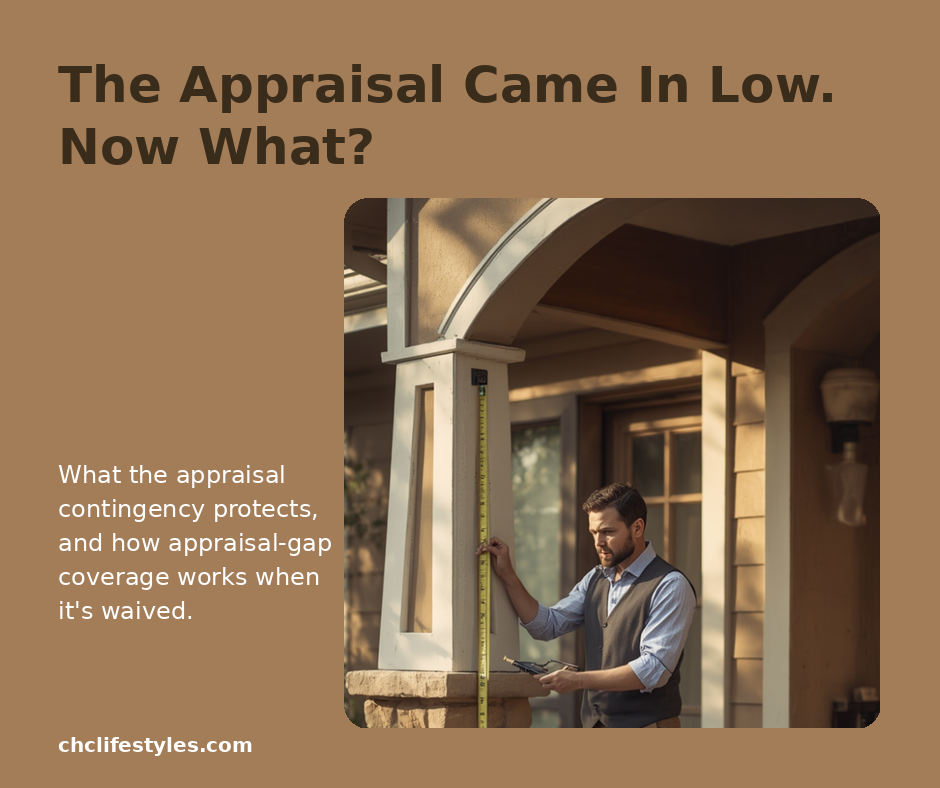
The Appraisal Came In Low. Now What?
A signed contract at the right price feels like the hard part is over. Then the appraisal comes in low, and suddenly everyone's asking what happens next.
What an Appraisal Actually Is
An appraisal is the lender's own check that the home is worth what they're about to loan against. It's ordered after the contract is signed, performed by a licensed, independent appraiser who has no stake in whether the deal closes, and it's designed to protect the bank — not the buyer or seller directly.
That distinction matters. The appraisal isn't a market analysis, a home inspection, or a judgment on how nice the house is. It's a valuation opinion based on comparable sales, market conditions, and the property's condition on a specific day.
The Appraisal Contingency — What It Actually Protects
If the contract includes an appraisal contingency and the home appraises below the contract price, the buyer generally has a few paths. They can ask the seller to reduce the price to the appraised value. They can agree to cover the gap themselves in cash. Or, if no resolution is reached within the contingency timeline, they can walk away and have their earnest money returned.
Like the inspection contingency and the financing contingency, this is a negotiation checkpoint with a real deadline — not an automatic do-over. Time is of the Essence applies here just as much as anywhere else in the contract.
Appraisal Gap Coverage — What Buyers Are Actually Agreeing To
In competitive markets, buyers sometimes waive the appraisal contingency outright or agree in advance to cover some or all of the gap up to a stated dollar cap. That can make an offer look stronger on paper, but sellers should understand exactly what's been waived and what hasn't before treating any offer as bulletproof.
A capped gap commitment, for example, means the buyer will bring extra cash up to a certain amount if the appraisal falls short — but anything beyond that cap can still be negotiated or can still let the buyer walk. A full waiver means the buyer is committing to close at the contract price regardless of appraisal, which is a very different risk profile. Make sure you know which one you're looking at.
What a Low Appraisal Doesn't Automatically Mean
A low appraisal is not a verdict on your home's true value. It's one appraiser's opinion, based on the comparables they could find, on a specific day. If the comparable sales were thin, if the appraiser wasn't familiar with the local market, or if the property has features that aren't easy to compare, the number can come in below what a willing buyer was ready to pay.
Sellers can challenge an appraisal or ask for a second one, but the lender isn't required to accept either. Sometimes the best path is to find a compromise with the buyer; sometimes the deal simply doesn't close. The key is knowing your options before you're backed into a corner.
A Seller's Perspective
The best protection against a low appraisal is pricing realistically from the start. An offer at or above list price is only as good as the appraisal that backs it up — which is why pricing conversations should be grounded in real closed comparable sales, not optimistic guesses or the highest number a buyer was willing to write.
This is the same reason I stress net proceeds over list price. The number on the sign doesn't matter if the deal renegotiates later. For more on what actually lands in your account, see what you actually take home.
If You Choose the Direct Purchase Path Instead
None of this applies if you sell directly. There's no appraisal contingency to manage, no lender-driven valuation that can change the deal later, and no gap coverage to parse. The offer is based on the property's realistic value up front, in writing, so what you see is what you get.
That's the same trade-off covered in cash offer vs. listing — a direct purchase isn't right for everyone, but for sellers who want certainty, it removes a lot of the variables that can derail a traditional closing.
The Form Changed Here Too
Same note as the last post in this series: the Virginia REALTORS® Residential Contract of Purchase went through a significant revision effective May 5, 2026, and the appraisal and financing language was part of what changed, along with inspection. If your last transaction predates that, don't assume the paragraph reads the way you remember. I keep current on which version applies to any contract I'm working from.
Where My Background Actually Helps
Because I'm also a licensed Class A contractor — on my own renovation projects here on the Shore, not as a repair contractor for clients — I look at valuation questions through a different lens than an agent who has only sold houses. I know what it actually costs to replace a roof, update a kitchen, or address site issues, and that context helps me talk through whether an appraisal gap is worth negotiating or whether the realistic path is to reset and try again.
That's the same thread running through this whole series — on Time is of the Essence, on as-is, on the financing contingency, on earnest money, and on home inspections. Years on real estate association Standard Forms Committees — vice chair, then chair, on the Northern Virginia Association of REALTORS® committee during my Northern Virginia career — is why I read these paragraphs the way I do.
One Important Disclaimer
I am not an attorney, and I am not a licensed appraiser — I don't perform appraisals, and nothing here is legal or valuation advice. What I can offer is direct, hands-on construction experience and a clear explanation of what your contract options mean in practice. For legal advice specific to your contract, consult a licensed Virginia real estate attorney; for valuation questions, consult a licensed Virginia appraiser.
Got a low appraisal and not sure what your options are — or want an offer that's already built around a realistic number? Call or text me directly at 540-729-7801, or email Chuck@ChuckCornwell.com. No forms, no call center — just a conversation.